Classic Materials on the Rise in the Winter Mountains
G-1000® is Fjällräven's own unique fabric that has become a major favorite. Combined with Greenland Wax, it's extremely durable, well-ventilating, and wind/water resistant.

G-1000® is Fjällräven’s own unique fabric that over the years has become a major favorite. The dense weave combined with Greenland Wax makes G-1000® extremely durable, well-ventilating, and also wind and water resistant. The tightly woven fabric is marketed for protection against mosquitoes and sunlight. The Greenland Wax makes it easy to customize the G-1000® garment’s performance for different weather and activity levels.
The advance of G-1000 is confirmed by Lars-Ola Brolinson, Sweden Manager at Naturkompaniet: – We see that more and more customers are recognizing the versatility and durability of G-1000. Sales of G-1000 products have increased in recent years. This is because more people are learning about the material’s advantages, and Fjällräven has broadened the range of G-1000 garments and also developed the material so it comes in four different variants. Particularly well-received is G-1000 Lite, which maintains high durability and wind resistance but is lighter and more quick-drying.
The Greenland Expedition of 1966 Changed Our Clothing
The Fjällräven-sponsored Greenland expedition in 1966 was one of Sweden’s most successful expeditions to Greenland. The expedition was a collaboration with Friluftsfrämjandet (the Swedish Outdoor Association) and a number of glacier researchers with alpine backgrounds. The expedition provided fantastic knowledge not only about glaciers but also outdoor techniques under difficult conditions. No fewer than 30 peaks were summited, five of which were of very high difficulty.
Using a specially developed fabric that proved too heavy for lightweight tents, Fjällräven’s founder Åke Nordin sewed the first Fjällräven garments in 1968. By adding a mixture of beeswax and paraffin, the fabric gained excellent properties for outdoor use. The fabric was named G-1000®, with “G” standing for the Greenland expedition. The wax was named Greenland Wax. Since then, the combination has proven its strength on countless adventures.
Fabric With or Without Membrane?
Many people put on a waterproof “technical” shell jacket out of pure habit. But anyone who has hiked or skied in a taped, laminated garment knows that it’s often too sealed. A laminated fabric can’t release the body moisture that forms when you move and get sweaty fast enough. That’s why experienced outdoor people have for decades instead chosen garments in G-1000® material. A fabric without membrane that protects against wind and withstands light showers. At the same time, G-1000® ventilates better so you avoid getting wet from sweat. Compared to laminated fabric, G-1000® is also much more durable. G-1000® handles nature’s sometimes sharp edges and even survives sparks from a campfire.


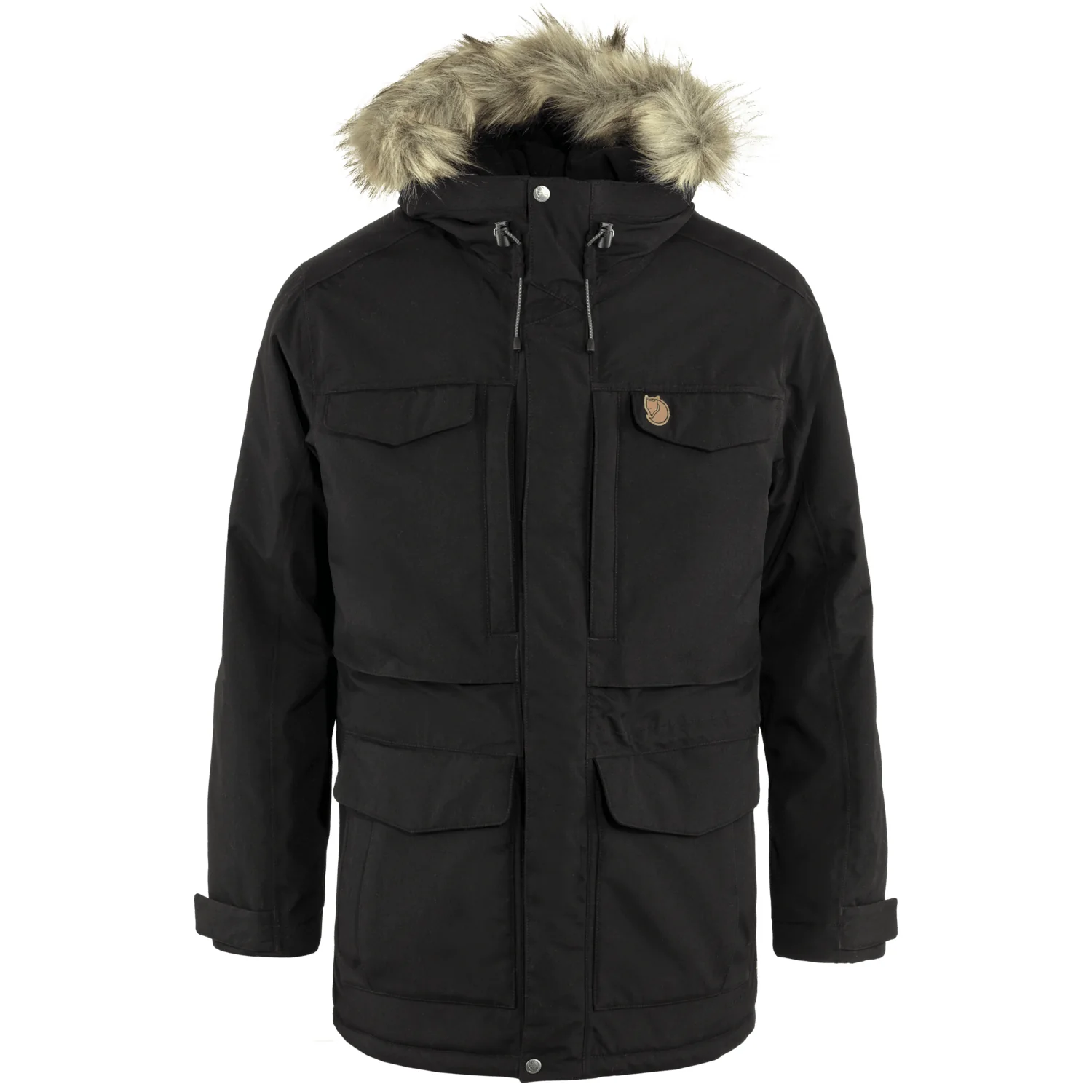
Övik Jacket – New winter down jacket in durable G-1000 Silent with a matte brushed surface.
Johan Skullman has worked for 30 years in the Swedish Armed Forces, most recently as head of testing and product development. Today Johan is an independent product expert for Fjällräven.
– Today, aggressive marketing of membrane fabrics – so-called shell garments – and their properties has been very successful. However, more and more people are realizing that non-membrane fabrics like G-1000 are more useful year-round in all climates and weather conditions. It’s a durable and adaptable material that fits well with the layering principle. It’s really only in heavy rain and strong wind that waterproof shell garments are needed, and then they can often be replaced with light, packable, thin shells that are pulled on and off as needed. This is also why military personnel worldwide and people in professions that use clothing for professional outdoor use almost exclusively use non-membrane fabrics. When shell garments are used in these groups, they serve as reinforcement layers.
Says Johan Skullman.